

-
1 odległość skuteczna
• decisive rangeSłownik polsko-angielski dla inżynierów > odległość skuteczna
-
2 дальность действительного огня
1) Military: decisive range, effective distance, effective range of fire, killing range, vulnerable range2) Artillery: battle range3) Astronautics: effective range4) Arms production: combat rangeУниверсальный русско-английский словарь > дальность действительного огня
-
3 эффективная дальность действия
Astronautics: decisive range, useful rangeУниверсальный русско-английский словарь > эффективная дальность действия
-
4 dirigir
v.1 to steer (conducir) (coche, barco).2 to manage (llevar) (empresa, hotel, hospital).dirige mi tesis, me dirige la tesis he's supervising my thesis, he's my PhD supervisor3 to direct.Ella dirigió el caso She directed the case.Ella dirige al equipo She directs the team.4 to address (carta, paquete).5 to guide (guiar) (person).6 to point, to range.Ellos dirigen al misil They point the missile.7 to drive, to steer, to pilot, to head.Ella dirige el avión She drives the plane.8 to conduct.Ella dirige la orquesta She conducts the orchestra.* * *(g changes to j before a and o)Present Indicativedirijo, diriges, dirige, dirigimos, dirigís, dirigen.Present SubjunctiveImperative* * *verb1) to direct, lead2) conduct3) address* * *1. VT1) (=orientar) [+ persona] to direct; [+ asunto] to advise, guidelo dirigió con ayuda de un mapa — she showed him the way o directed him with the help of a map
¿por qué no vas tú delante y nos diriges? — why don't you go first and lead the way?
palabra 2)dirigían sus pasos hacia la iglesia — they made their way o walked towards the church
2) (=apuntar) [+ arma, telescopio] to aim, point (a, hacia at)[+ manguera] to turn (a, hacia on) point (a, hacia at)dirigió los focos al escenario — he pointed o directed the lights towards the stage
ordenó dirigir el fuego hacia el enemigo — he ordered them to direct o aim their fire at the enemy
3) (=destinar)a) [+ carta, comentario, pregunta] to address (a to)b) [+ libro, programa, producto] to aim (a at)c) [+ acusación, críticas] to make (a, contra against)level (a, contra at, against) [+ ataques] to make (a, contra against)dirigieron graves acusaciones contra el ministro — serious accusations were made against the minister, serious accusations were levelled at o against the minister
le dirigieron fuertes críticas — he was strongly criticized, he came in for some strong criticism
d) [+ esfuerzos] to direct (a, hacia to, towards)hay que dirigir todos nuestros esfuerzos hacia este fin — we must direct all our efforts to this end
4) (=controlar) [+ empresa, hospital, centro de enseñanza] to run; [+ periódico, revista] to edit, run; [+ expedición, país, sublevación] to lead; [+ maniobra, operación, investigación] to direct, be in charge of; [+ debate] to chair; [+ proceso judicial] to preside over; [+ tesis] to supervise; [+ juego, partido] to refereeel Partido Comunista dirigió los destinos del país durante siete décadas — the Communist Party controlled the fate of the country for seven decades
cotarro 1)dirigió mal las negociaciones — he handled the negotiations badly, he mismanaged the negotiations
5) (Cine, Teat) to direct6) (Mús) [+ orquesta, concierto] to conduct; [+ coro] to lead¿quién dirigirá el coro? — who will be the choirmaster?, who will lead the choir?
7) (=conducir) [+ coche] to drive; [+ barco] to steer; [+ caballo] to leaddirigió su coche hacia la izquierda — he steered o drove his car towards the left
2.See:* * *1.verbo transitivo1)a) < empresa> to manage, run; <periódico/revista> to run, edit; <investigación/tesis> to supervise; < debate> to lead, chairdirigir el tráfico — to direct o control the traffic
b) <obra/película> to directc) < orquesta> to conduct2)a)dirigir algo a alguien — <mensaje/carta> to address something to somebody; < críticas> to direct something to somebody
b)dirigir algo hacia or a algo/alguien — < telescopio> to point something toward(s) something/somebody; < pistola> to point something toward(s) something/somebody
dirigir la mirada hacia or a algo/alguien — to look at something/somebody
3) ( encaminar)2.dirigir algo a + inf — < esfuerzos> to channel something into -ing; <energía/atención> to direct something toward(s) -ing
dirigirse v pron1) ( encaminarse)2)dirigirse a alguien — ( oralmente) to speak o talk to somebody; ( por escrito) to write to somebody
me dirijo a Vd. para solicitarle... — (Corresp) I am writing to request...
* * *= address, channel, direct, gear (to/toward(s)/for), lead, man, pitch, route, run, steer, head, signpost, give + direction, angle, rule over, lend + direction, shepherd, choreograph, key + Nombre + to.Ex. More can be assumed in instructions addressed to the experienced information searcher than in instructions for the novice.Ex. Users make suggestions for modifications and these are then channelled through a series of committees.Ex. This statement directs the user to adopt a number more specific terms in preference to the general term.Ex. Most of the main subject headings lists are geared to the alphabetical subject approach found in dictionary catalogues.Ex. A book index is an alphabetically arranged list of words or terms leading the reader to the numbers of pages on which specific topics are considered, or on which specific names appear.Ex. The responsibility for manning the one telephone left at the disposal of a residue of callers fell to a single officer who had other duties to carry out to justify his keep.Ex. Thus pitching instructions at the right level can be difficult.Ex. Requests which cannot be filled by local or regional libraries are automatically routed by the system to NLM as the library of last resort.Ex. The service is run by Radio-Suisse and can be accessed via de PSS.Ex. They decided that they had to set up information and referral services to steer people to the correct agency.Ex. A stickler for details, sometimes to the point of compulsion, Edmonds was deemed a fortuitous choice to head the monumental reorganization process.Ex. There is a need for a firststop organization that could signpost the public through the maze of government agencies and social welfare organizations.Ex. To give direction to these physical resources, there are objectives for the project and a framework timetable.Ex. This publication seems to find particular favour in law firms, possibly because of its currency and the way it is angled towards the commercial world.Ex. From the impressive library of his mansion home on Beacon Hill, Ticknor ruled over Boston's intellectual life and was looked to as the leading arbiter of intellectual and social life in that great city.Ex. Policies are guidelines that lend direction to planning and decision-making.Ex. He showed the ability of a single mind to shepherd cultural ventures.Ex. Response to reading room theft should be carefully choreographed but decisive.Ex. The case study found that children do have the ability to use a classification scheme that is keyed to their developmental level.----* dirigir el cotarro = call + the shots, be the boss, call + the tune, rule + the roost.* dirigir el esfuerzo = direct + effort, direct + energy.* dirigir información a = direct + information towards.* dirigir interpretación musical = conduct.* dirigir la atención = put + focus.* dirigir la atención a = turn to, direct + Posesivo + attention to(ward).* dirigir la mirada hacia = look toward(s).* dirigir la palabra = be civil towards.* dirigir los intereses de uno = break into.* dirigir + Posesivo + atención = turn + Posesivo + attention, turn + Posesivo + thoughts.* dirigir + Posesivo + atención a un problema = turn + Posesivo + attention to problem.* dirigir + Posesivo + mirada = turn + Posesivo + thoughts.* dirigirse = be headed, head, head out.* dirigirse a = aim at, check with, turn over to, turn to, make + Posesivo + way to, set off to, turn to, head for, reach out to, head off for/to.* dirigirse a Alguien = approach + Alguien.* dirigirse amenazadoramente hacia = bear down on.* dirigirse a toda prisa hacia = make + haste towards.* dirigirse en multitud = beat + the path to.* dirigirse hacia = be on + Posesivo + way to, start toward, move toward(s), be heading towards, head for, turn into.* dirigirse hacia + Dirección = push + Dirección.* dirigirse hacia el oeste = push + westward(s).* dirigirse la palabra = on speaking terms.* dirigirse rápidamente hacia = make + haste towards.* dirigir una crítica hacia = level + criticism at.* dirigir una tesis = supervise + dissertation, supervise + thesis.* dirigir un servicio = run + service.* lectura no dirigida = undirected reading.* * *1.verbo transitivo1)a) < empresa> to manage, run; <periódico/revista> to run, edit; <investigación/tesis> to supervise; < debate> to lead, chairdirigir el tráfico — to direct o control the traffic
b) <obra/película> to directc) < orquesta> to conduct2)a)dirigir algo a alguien — <mensaje/carta> to address something to somebody; < críticas> to direct something to somebody
b)dirigir algo hacia or a algo/alguien — < telescopio> to point something toward(s) something/somebody; < pistola> to point something toward(s) something/somebody
dirigir la mirada hacia or a algo/alguien — to look at something/somebody
3) ( encaminar)2.dirigir algo a + inf — < esfuerzos> to channel something into -ing; <energía/atención> to direct something toward(s) -ing
dirigirse v pron1) ( encaminarse)2)dirigirse a alguien — ( oralmente) to speak o talk to somebody; ( por escrito) to write to somebody
me dirijo a Vd. para solicitarle... — (Corresp) I am writing to request...
* * *= address, channel, direct, gear (to/toward(s)/for), lead, man, pitch, route, run, steer, head, signpost, give + direction, angle, rule over, lend + direction, shepherd, choreograph, key + Nombre + to.Ex: More can be assumed in instructions addressed to the experienced information searcher than in instructions for the novice.
Ex: Users make suggestions for modifications and these are then channelled through a series of committees.Ex: This statement directs the user to adopt a number more specific terms in preference to the general term.Ex: Most of the main subject headings lists are geared to the alphabetical subject approach found in dictionary catalogues.Ex: A book index is an alphabetically arranged list of words or terms leading the reader to the numbers of pages on which specific topics are considered, or on which specific names appear.Ex: The responsibility for manning the one telephone left at the disposal of a residue of callers fell to a single officer who had other duties to carry out to justify his keep.Ex: Thus pitching instructions at the right level can be difficult.Ex: Requests which cannot be filled by local or regional libraries are automatically routed by the system to NLM as the library of last resort.Ex: The service is run by Radio-Suisse and can be accessed via de PSS.Ex: They decided that they had to set up information and referral services to steer people to the correct agency.Ex: A stickler for details, sometimes to the point of compulsion, Edmonds was deemed a fortuitous choice to head the monumental reorganization process.Ex: There is a need for a firststop organization that could signpost the public through the maze of government agencies and social welfare organizations.Ex: To give direction to these physical resources, there are objectives for the project and a framework timetable.Ex: This publication seems to find particular favour in law firms, possibly because of its currency and the way it is angled towards the commercial world.Ex: From the impressive library of his mansion home on Beacon Hill, Ticknor ruled over Boston's intellectual life and was looked to as the leading arbiter of intellectual and social life in that great city.Ex: Policies are guidelines that lend direction to planning and decision-making.Ex: He showed the ability of a single mind to shepherd cultural ventures.Ex: Response to reading room theft should be carefully choreographed but decisive.Ex: The case study found that children do have the ability to use a classification scheme that is keyed to their developmental level.* dirigir el cotarro = call + the shots, be the boss, call + the tune, rule + the roost.* dirigir el esfuerzo = direct + effort, direct + energy.* dirigir información a = direct + information towards.* dirigir interpretación musical = conduct.* dirigir la atención = put + focus.* dirigir la atención a = turn to, direct + Posesivo + attention to(ward).* dirigir la mirada hacia = look toward(s).* dirigir la palabra = be civil towards.* dirigir los intereses de uno = break into.* dirigir + Posesivo + atención = turn + Posesivo + attention, turn + Posesivo + thoughts.* dirigir + Posesivo + atención a un problema = turn + Posesivo + attention to problem.* dirigir + Posesivo + mirada = turn + Posesivo + thoughts.* dirigirse = be headed, head, head out.* dirigirse a = aim at, check with, turn over to, turn to, make + Posesivo + way to, set off to, turn to, head for, reach out to, head off for/to.* dirigirse a Alguien = approach + Alguien.* dirigirse amenazadoramente hacia = bear down on.* dirigirse a toda prisa hacia = make + haste towards.* dirigirse en multitud = beat + the path to.* dirigirse hacia = be on + Posesivo + way to, start toward, move toward(s), be heading towards, head for, turn into.* dirigirse hacia + Dirección = push + Dirección.* dirigirse hacia el oeste = push + westward(s).* dirigirse la palabra = on speaking terms.* dirigirse rápidamente hacia = make + haste towards.* dirigir una crítica hacia = level + criticism at.* dirigir una tesis = supervise + dissertation, supervise + thesis.* dirigir un servicio = run + service.* lectura no dirigida = undirected reading.* * *dirigir [I7 ]vtA1 ‹empresa› to manage, run; ‹periódico/revista› to run, edit; ‹investigación/tesis› to supervise; ‹debate› to lead, chairdirigió la operación de rescate he led o directed the rescue operationdirigir el tráfico to direct o control the traffic2 ‹obra/película› to direct3 ‹orquesta› to conductB1 ‹mensaje/carta› dirigir algo A algn to address sth TO sbesta noche el presidente dirigirá un mensaje a la nación the president will address the nation tonightla carta venía dirigida a mí the letter was addressed to medirigió unas palabras de bienvenida a los congresistas he addressed a few words of welcome to the delegateslas críticas iban dirigidas a los organizadores the criticisms were directed at the organizersel folleto va dirigido a padres y educadores the booklet is aimed at parents and teachersla pregunta iba dirigida a usted the question was meant for you, I asked you the questionno me dirigió la palabra he didn't say a word to me2 ‹mirada/pasos/telescopio›dirigió la mirada hacia el horizonte he looked toward(s) the horizon, he turned his eyes o his gaze toward(s) the horizonle dirigió una mirada de reproche she looked at him reproachfully, she gave him a reproachful lookdirigió sus pasos hacia la esquina he walked toward(s) the cornerdirigió el telescopio hacia la luna he pointed the telescope toward(s) the moonC (encaminar) ‹esfuerzos/acciones› dirigir algo A + INF:acciones dirigidas a aliviar el problema measures aimed at alleviating o measures designed to alleviate the problemdirigiremos todos nuestros esfuerzos a lograr un acuerdo we shall channel all our efforts into o direct all our efforts toward(s) reaching an agreementA(ir): nos dirigíamos al aeropuerto we were heading for o we were going to o we were on our way to the airportse dirigió a su despacho con paso decidido he strode purposefully toward(s) his officese dirigían hacia la frontera they were making o heading for the borderel buque se dirigía hacia la costa the ship was heading for o toward(s) the coastB dirigirse A algn (oralmente) to speak o talk TO sb, address sb ( frml) (por escrito) to write TO sb¿se dirige a mí? are you talking o speaking to me?me dirijo a Vd. para solicitarle … ( Corresp) I am writing to request …para más información diríjase a … for more information please write to o contact …* * *
dirigir ( conjugate dirigir) verbo transitivo
1
‹periódico/revista› to run, edit;
‹investigación/tesis› to supervise;
‹ debate› to lead, chair;
‹ tráfico› to direct
‹ orquesta› to conduct
2a) dirigir algo a algn ‹mensaje/carta› to address sth to sb;
‹ críticas› to direct sth to sb;
no me dirigió la palabra he didn't say a word to me
‹ pistola› to point sth toward(s) sth/sb;
dirigir la mirada hacia or a algo/algn to look at sth/sb;
3 ( encaminar) dirigir algo a hacer algo ‹ esfuerzos› to channel sth into doing sth;
‹energía/atención› to direct sth toward(s) doing sth
dirigirse verbo pronominal
1 ( encaminarse): dirigirse hacia algo to head for sth
2 dirigirse a algn ( oralmente) to speak o talk to sb;
( por escrito) to write to sb
dirigir verbo transitivo
1 (estar al mando de) to direct
(una empresa) to manage
(un negocio, una escuela) to run
(un sindicato, partido) to lead
(un periódico) to edit
2 (una orquesta) to conduct
(una película) to direct
3 (hacer llegar unas palabras, un escrito) to address
(una mirada) to give
4 (encaminar, poner en una dirección) to direct, steer: dirigió el coche hacia la salida, he drove his car to the exit
dirigió la mirada hacia la caja fuerte, she looked towards the strongbox
dirigió sus pasos hacia el bosque, he made his way towards the wood
' dirigir' also found in these entries:
Spanish:
cruzar
- derivar
- destinar
- enchufar
- enfilar
- mandar
- manejar
- manipular
- orquestar
- palabra
- conducir
English:
address
- aim
- bend
- conduct
- control
- direct
- guide
- lead
- level
- manage
- mastermind
- operate
- pitch
- run
- shine
- spearhead
- steer
- turn
- edit
- head
- produce
- target
* * *♦ vt1. [conducir] [coche, barco] to steer;[avión] to pilot;el canal dirige el agua hacia el interior de la región the canal channels the water towards the interior of the region2. [estar al cargo de] [empresa, hotel, hospital] to manage;[colegio, cárcel, periódico] to run; [partido, revuelta] to lead; [expedición] to head, to lead; [investigación] to supervise;dirige mi tesis, me dirige la tesis he's supervising my thesis, he's my PhD supervisor o US advisor3. [película, obra de teatro] to direct;[orquesta] to conductdirige el telescopio al norte point the telescope towards the north;dirigió sus acusaciones a las autoridades her accusations were aimed at the authorities5. [dedicar, encaminar]nos dirigían miradas de lástima they were giving us pitying looks, they were looking at us pityingly;dirigir unas palabras a alguien to speak to sb, to address sb;dirige sus esfuerzos a incrementar los beneficios she is directing her efforts towards increasing profits, her efforts are aimed at increasing profits;dirigen su iniciativa a conseguir la liberación del secuestrado the aim of their initiative is to secure the release of the prisoner;dirigió sus pasos hacia la casa he headed towards the house;no me dirigen la palabra they don't speak to me;un programa dirigido a los amantes de la música clásica a programme (intended) for lovers of classical music;consejos dirigidos a los jóvenes advice aimed at the young6. [carta, paquete] to address7. [guiar] [persona] to guide* * *v/t2 COM manage, run3:dirigir una carta a address a letter to;dirigir una pregunta a direct a question to4 ( conducir) lead* * *dirigir {35} vt1) : to direct, to lead2) : to address3) : to aim, to point4) : to conduct (music)* * *dirigir vb1. (película, tráfico) to directJames Cameron dirigió "Titanic" James Cameron directed "Titanic"2. (empresa, equipo) to manage¿quién dirige la selección española? who manages the Spanish national team?5. (libro, medida) to aim / to direct6. (carta, palabras) to addressdirigió sus comentarios a todos los jóvenes presentes she addressed her comments to all the young people who were there7. (orquesta) to conduct -
5 categórico
adj.categorical, determined, decisive, adamant.* * *► adjetivo1 categoric, categorical\un no categórico a flat refusal* * *ADJ [respuesta] categorical; [mentira] outright, downright; [orden] express* * *afirmó en términos categóricos que... — he stated categorically that...
* * *= categorical, categorical, authoritative, blunt, uncompromising, forthright, categoric.Ex. There is a categorical moral imperative for a deepening and a renewal of the concept of collegiality -- that is a blend of intense competition and mutual support -- in relations between research scholars and research librarians.Ex. There is a categorical moral imperative for a deepening and a renewal of the concept of collegiality -- that is a blend of intense competition and mutual support -- in relations between research scholars and research librarians.Ex. While the operating instructions must be regarded as authoritative, they should not be seen as sacrosanct tablets of stone.Ex. The author discusses the range of enquiries he deals with, the sources of information he uses, and the blunt attitude with which he deals with many enquirers.Ex. What precipitated that furor was that Panizzi's volume represented a uncompromising rejection of the comfortable ideology of the finding catalog.Ex. We have been told once, in clear and forthright terms, what it is that we need.Ex. The question of the need for categoric assurances is not locked into a 12 month timeframe or any other timeframe.----* afirmación categórica = bold statement.* * *afirmó en términos categóricos que... — he stated categorically that...
* * *= categorical, categorical, authoritative, blunt, uncompromising, forthright, categoric.Ex: There is a categorical moral imperative for a deepening and a renewal of the concept of collegiality -- that is a blend of intense competition and mutual support -- in relations between research scholars and research librarians.
Ex: There is a categorical moral imperative for a deepening and a renewal of the concept of collegiality -- that is a blend of intense competition and mutual support -- in relations between research scholars and research librarians.Ex: While the operating instructions must be regarded as authoritative, they should not be seen as sacrosanct tablets of stone.Ex: The author discusses the range of enquiries he deals with, the sources of information he uses, and the blunt attitude with which he deals with many enquirers.Ex: What precipitated that furor was that Panizzi's volume represented a uncompromising rejection of the comfortable ideology of the finding catalog.Ex: We have been told once, in clear and forthright terms, what it is that we need.Ex: The question of the need for categoric assurances is not locked into a 12 month timeframe or any other timeframe.* afirmación categórica = bold statement.* * *categórico -ca‹respuesta› categoricalrespondió con un sí categórico his reply was a definite o a categorical o an unequivocal yesafirmó en términos categóricos que … he stated in no uncertain terms o categorically that …* * *
categórico◊ -ca adjetivo ‹ respuesta› categorical
categórico,-a adjetivo categorical: le dije de manera categórica que no, I refused point blank
' categórico' also found in these entries:
Spanish:
categórica
- radical
English:
categoric
- categorical
- decided
- emphatic
- flat
- explicit
- steadfast
- straight
* * *categórico, -a adjcategorical;respondió con un “no” categórico he replied with a most emphatic “no”* * *adj categorical* * *categórico, -ca adj: categorical, unequivocal♦ categóricamente adv -
6 धर्मः _dharmḥ
धर्मः [ध्रियते लोको$नेन, धरति लोकं वा धृ-मन्; cf. Uṇ 1. 137]1 Religion; the customary observances of a caste, sect, &c.-2 Law, usage, practice, custom, ordinance, statue.-3 Religious or moral merit, virtue, right- eousness, good works (regarded as one of the four ends of human existence); अनेन धर्मः सविशेषमद्य मे त्रिवर्ग- सारः प्रतिभाति भाविनि Ku.5.38, and see त्रिवर्ग also; एक एव सुहृद्धर्मो निधने$प्यनुयाति यः H.1.63.-4 Duty, prescribed course of conduct; षष्ठांशवृत्तेरपि धर्म एषः Ś.5.4; Ms.1.114.-5 Right, justice, equity, impartiality.-6 Piety, propriety, decorum.-7 Morality, ethics-8 Nature. disposition, character; उत्पत्स्यते$स्ति मम को$पि समानधर्मा Māl.1.6; प्राणि˚, जीव˚.-9 An essential quality, pecu- liarity, characteristic property, (peculiar) attribute; वदन्ति वर्ण्यावर्ण्यानां धर्मैक्यं दीपकं बुधाः Chandr.5.45; Pt.1.34.-1 Manner, resemblance, likeness.-11 A sacrifice.-12 Good company, associating with the virtuous-13> Devotion, religious abstraction.-14 Manner, mode.-15 An Upaniṣad q. v.-16 N. of Yudhiṣṭhira, the eldest Pāṇḍava.-17 N. of Yama, the god of death.-18 A bow.-19 A drinker of Soma juice.-2 (In astrol.) N. of the ninth lunar man- sion.-21 An Arhat of the Jainas.-22 The soul.-23 Mastery, great skill; दिव्यास्त्रगुणसंपन्नः परं धर्मं गतो युधि Rām.3.31.15.-र्मम् A virtuous deed.-Comp. -अक्षरम् (pl.) holy mantras; a formula of faith; धर्माक्षराण्युदाहरामि Mk.8.45-46.-अङ्गः (-ङ्गा f.) the Indian crane.-अधर्मौ m. (du.) right and wrong, religion and irreligion; धर्माधर्मौ सपदि गलितौ पुण्यपापे विशीर्णे. ˚विद् m. a Mīmāṁsaka who knows the right and wrong course of action.-अधिकरणम् 1 administration of the laws.1 a court of justice. (-णः) a judge.-अधिकरणिकः, -अधिकारिन् m. a judge, magistrate, any judicial functionary.-अधिकरणिन् m. a judge, magistrate.-अधिकारः 1 superintendence of religious affairs; Ś1.-2 ad- ministration of justice.-3 the office of a judge.-अधि- ष्ठानम् a court of justice.-अध्यक्षः 1 a judge.-2 an epithet of Viṣṇu.-अनुष्ठानम् acting according to religion, virtuous or moral conduct.-अनुसारः conformity to virtue or justice.-अपेत a. deviating from virtue, wicked, immoral, irreligious. (-तम्) vice, immorality, injustice.-अयनम् course of law, law-suit.-अरण्यम् a sacred or penance grove, a wood inhabited by ascetics; धर्मारण्यं प्रविशति गजः Śi.1.32.-अर्थौः religious merit and wealth; धर्मार्थौ यत्र न स्याताम् Ms.2.112.-अर्थम् ind.1 for religious purposes.-2 justly, according to justice or right.-अलीक a. having a false character.-अस्तिकायः (with Jainas) the category or predicament of virtue; cf. अस्तिकाय.-अहन् Yesterday.-आगमः a religious statute, lawbook.-आचार्यः 1 a religious teacher.-2 a teacher of law or customs.-आत्मजः an epithet of Yudhiṣṭhira q. v.-आत्मता religiousmindedness; justice, virtue.-आत्मन् a. just righteous, pious, virtuous. (-m.) a saint, a pious man.-आश्रय, -आश्रित a. righteous, virtuous; धर्माश्रयं पापिनः (निन्दन्ति) Pt.1.415.-आसनम् the throne of justice, judgmentseat, tribunal; न संभावितमद्य धर्मासनमध्यासितुम् Ś.6; धर्मासनाद्विशति वासगृहं नरेन्द्रः U.1.7.-इन्द्रः, -ईशः an epithet of Yama; पितॄणामिव धर्मेन्द्रः Mb.7.6.6.-ईप्सु a. wishing to gain religious merit; Ms.1.127.-उत्तर a. 'rich in virtue,' chiefly characterized by justice, eminently just and impartial; धर्मोत्तरं मध्यममाश्रयन्ते R.13.7.-उपचायिन् a. religious; यच्च वः प्रेक्षमाणानां सर्व- धर्मोपचायिनाम् Mb.5.137.16.-उपदेशः 1 instruction in law or duty, religious or moral instruction. आर्षं धर्मोपदेशं च वेदशास्त्राविरोधिना । यस्तर्केणानुसंधत्ते स धर्मं वेद नेतरः ॥ Ms.12.16.-2 the collective body of laws.-उपदेशकः 1 a teacher of the law.-2 a spiritual teacher, a Guru.-कथकः an expounder of law.-कर्मन् n.,-कार्यम्, -क्रिया 1 any act of duty or religion, any moral or religious observance, a religious act or rite.-2 virtuous conduct.-कथादरिद्रः the Kali age.-काम a.1 devoted to virtue.-2 observing duty or right.-कायः 1 an epithet of Buddha.-2 a Jaina saint.-कारणम् Cause of virtue.-कीलः 1 a grant, royal edict or decree.-2 husband.-कृत् a. observing duty, acting justly. (-m.)1 N. of Viṣṇu.-2 a pious man. धर्मा- धर्मविहीनो$पि धर्ममर्यादास्थापनार्थं धर्ममेव करोतीति धर्मकृत् Bhāg.-केतुः an epithet of Buddha.-कोशः, -षः the collective body of laws or duties; धर्मकोषस्य गुप्तये Ms.1.99.-क्रिया, -कृत्यम् any act of religion, any moral or religious rite.-क्षेत्रम् 1 Bhāratavarṣa (the land of religion).-2 N. of a plain near Delhi, the scene of the great battle between the Kauravas and Pāṇḍavas; धर्मक्षेत्रे कुरुक्षेत्रे समवेता युयुत्सवः Bg.1.1. (-त्रः) a virtuous or pious man.-गुप्त a. observing and protecting religion. (-प्तः) N. of Viṣṇu.-ग्रन्थः a sacred work or scripture.-घटः a jar of fragrant water offered daily (to a Brāhmaṇa) in the month of Vaiśākha; एष धर्मघटो दत्तो ब्रह्माविष्णुशिवात्मकः । अस्य प्रदानात् सफला मम सन्तु मनोरथाः ॥-घ्न a. immoral, unlawful.-चक्रः 1 The wheel or range of the law; Bhddh. Jain.-2 a Buddha. ˚मृत् m. a Buddha or Jaina.-चरणम्, -चर्या observance of the law, performance of religious duties; शिवेन भर्त्रा सह धर्मचर्या कार्या त्वया मुक्तविचारयेति Ku.7.83; वयसि प्रथमे, मतौ चलायां बहुदोषां हि वदन्ति धर्मचर्याम् Bu. Ch.5.3. चारिन् a. practising virtue, observing the law, virtuous, righteous; स चेत्स्वयं कर्मसु धर्मचारिणां त्वमन्त- रायो भवसि R.3.45. (-m.) an ascetic.चारिणी 1 a wife.-2 a chaste or virtuous wife. cf. सह˚; इयं चोर्वशी यावदायुस्तव सहधर्मचारिणी भवत्विति V.5.19/2.-चिन्तक a.1 studying or familiar with duty.-2 reflecting on the law.-चिन्तनम्, चिन्ता study of virtue, consideration of moral duties, moral reflection.-च्छलः fraudulent transgression of law or duty.-जः 1 'duly or lawfully born', a legitimate son; cf. Ms.9.17.-2 N. of युधिष्ठिर; Mb.15.1.44.-जन्मन् m. N. of युधिष्ठिर.-जिज्ञासा inquiry into religion or the proper course of conduct; अथातो धर्मजिज्ञासा Jaimini's Sūtra.-जीवन a. one who acts according to the rules of his caste or fulfils prescribed duties. (-नः) a Brāhmaṇa who maintains himself by assisting other men in the performance of their reli- gious rites; यश्चापि धर्मसमयात्प्रच्युतो धर्मजीवनः Ms.9.273.-ज्ञ a.1 knowing what is right, conversant with civil or religious law; Ms.7.141;8.179;1.127.-2 just, righteous, pious.-त्यागः abandoning one's religion, apostacy.-दक्षिणा a fee for instruction in the law.-दानम् a charitable gift (made without any self-inte- rest.) पात्रेभ्यो दीयते नित्यमनपेक्ष्य प्रयोजनम् । केवलं धर्मबुद्ध्या यद् धर्मदानं प्रचक्षते ॥ Ms.3.262.-दुघा a cow milked for religious purposes only.-द्रवी N. of the Ganges.-दारा m. (pl.) a lawful wife; स्त्रीणां भर्ता धर्मदाराश्च पुंसाम् Māl. 6.18.-द्रुह् a. voilating the law or right; निसर्गेण स धर्मस्य गोप्ता धर्मद्रुहो वयम् Mv.2.7.-द्रोहिन् m. a demon.-धातुः an epithet of Buddha.-ध्वजः -ध्वजिन् m. a religious hypocrite, an impostor; Bhāg.3.32.39.-नन्दनः an epithet of युधिष्ठिर.-नाथः a legal protector, rightful master.-नाभः an epithet of Viṣṇu.-निबन्धिन् a. pious, holy.-निवेशः religious devotion.-निष्ठ a. devoted to religion or virtue; श्रीमन्तः पान्तु पृथ्वीं प्रशमित- रिपवो धर्मनिष्ठाश्च भूपाः Mk.1.61.-निष्पत्तिः f.1 discharge or fulfilment of duty.-2 moral or religious observance;-पत्नी a lawful wife; R.2.2,2,72;8.7; Y.2.128.-पथः the way of virtue, a virtuous course of conduct.-पर a. religious-minded, pious, righteous.-परिणामः rise of righteous conduct in the heart (Jainism); cf. also एतेन भूतेन्द्रियेषु धर्मलक्षणावस्थापरिणामा व्याख्याताः Yoga- darśana.-पाठकः a teacher of civil or religious law; Ms.12.111.-पालः 'protector of the law', said meta- phorically of (दण्ड) 'punishment or chastisement', or 'sword'.-पाडा transgressing the law, an offence against law.-पुत्रः 1 a lawful son, a son begotten from a sense of duty and not from mere lust or sensual pleasure.-2 an epithet of युधिष्ठिर.-3 any one regarded as a son for religious purposes, a spiritual son.-प्रचारः (fig.) sword.-प्रतिरूपकः a counterfeit of virtue; Ms.11.9.-प्रधान a. eminent in piety; धर्मप्रधानं पुरुषं तपसा हतकिल्बिषम् Ms.4.243.-प्रवक्तृ m.1 an expounder of the law, a legal adviser.-2 a religious teacher, prea- cher.-प्रवचनम् 1 the science of duty; U.5.23.-2 expounding the law. (-नः) an epithet of Buddha.-प्रेक्ष्य a. religious or virtuous (धर्मदृष्टि); Rām.2.85.16.-बाणिजिकः, -वाणिजिकः 1 one who tries to make profit out of his virtue like a merchant.-2 one who performs religious rites with a view to reward, like a merchant dealing in transactions for profit.-बाह्यः a. contrary to religion or what is right.-भगिनी 1 a lawful sister.-2 a daughter of the spiritual preceptor.-3 a spiritual sister, any one regarded as a sister or discharging the same religious duties एतस्मिन्विहारे मम धर्मभगिनी तिष्ठति Mk.8.46/47.-भागिनी a virtuous wife.-भाणकः a lecturer or public reader who reads and explains to audiences sacred books like the Bhārata, Bhāgavata, &c.-भिक्षुकः a mendicant from virtuous motives; Ms. 11.2.-भृत् m.1 'a preserver or defender of justice,' a king.-2 a virtuous person.-भ्रातृ m.1 a fellow reli- gious student, a spiritual brother.-2 any one regard- ed as a brother from discharging the same religious duties. वानप्रस्थयतिब्रह्मचारिणां रिक्थभागिनः । क्रमेणाचार्यसच्छिष्य- धर्मभ्रात्रेकतीर्थिनः ॥ Y.2.137.-महामात्रः a minister of reli- gion, a minister in charge of religious affairs.-मूलम् the foundation of civil or religious law, the Vedas.-मेघः a particular Samādhi.-युगम् the Kṛita age; अथ धर्मयुगे तस्मिन्योगधर्ममनुष्ठिता । महीमनुचचारैका सुलभा नाम भिक्षुकी Mb.12.32.7.-यूपः, -योनिः an epithet of Viṣṇu.-रति a. 'delighting in virtue or justice', righteous, pious, just; तस्य धर्मरतेरासीद् वृद्धत्वं जरसा विना R.1.23.-रत्नम् N. of a Jaina स्मृतिग्रन्थ prepared by Jīmūtavāhana.-राज् -m. an epithet of Yama.-राज a. धर्मशील q. v.; धर्मराजेन जनकेन महात्मना (विदेहान् रक्षितान्) Mb.12.325 19.-राजः an epithet of1 Yama.-2 Jina.-3 युधिष्ठिर.-4 a king.-राजन् m. N. of युधिष्ठिर.-राजिका a monument, a stūpa (Sārnāth Inscrip. of Mahīpāla; Ind. Ant. Vol.14, p.14.)-रोधिन् a.1 op- posed to law, illegal, unlawful.-2 immoral.-लक्षणम् 1 the essential mark of law.-2 the Vedas. (-णा) the Mīmāṁsā philosophy.-लोपः 1 irreligion, immorality.-2 violation of duty; धर्मलोपभयाद्राज्ञीमृतुस्नातामिमां स्मरन् R. 1.76.-वत्सल a. loving piety or duty.-वर्तिन् a. just, virtuous.-वर्धनः an epithet of Śiva.-वादः discussion about law or duty, religious controversy; अनुकल्पः परो धर्मो धर्मवादैस्तु केवलम् Mb.12.165.15.-वासरः 1 the day of full moon.-2 yesterday.-वाहनः 1 an epithet of Śiva.-2 a buffalo (being the vehicle of Yama).-विद् a. familiar with the law (civil or religious). ˚उत्तमः N. of Viṣṇu.-विद्या knowledge of the law or right.-विधिः a legal precept or injunction; एष धर्मविधिः कृत्स्नश्चातुर्वर्ण्यस्य कीर्तितः Ms.1.131.-विप्लवः violation of duty, immora- lity.-विवेचनम् 1 judicial investigation; यस्य शूद्रस्तु कुरुते राज्ञो धर्मविवेचनम् । तस्य सीदति तद्राष्ट्रं पङ्के गौरिव पश्यतः ॥ Ms.8.21.-2 dissertation on duty.-वीरः (in Rhet.) the sentiment of heroism arising out of virtue or piety, the sentiment of chivalrous piety; the following instance is given in R. G.:-- सपदि विलयमेतु राज्यलक्ष्मीरुपरि पतन्त्वथवा कृपाणधाराः । अपहरतुतरां शिरः कृतान्तो मम तु मतिर्न मनागपैतु धर्मात् ॥ स च दानधर्मयुद्धैर्दयया च समन्वितश्चतुर्धा स्यात् S. D.-वृद्ध a. advanced in virtue or piety; न धर्मवृद्धेषु वयः समीक्ष्यते Ku.5.16.-वैतंसिकः one who gives away money un- lawfully acquired in the hope of appearing generous.-व्यवस्था m. judicial decision, decisive sentence.-शाला 1 a court of justice, tribunal.-2 any charitabla institu- tion.-शासनम्, शास्त्रम् a code of laws, jurisprudence; न धर्मशास्त्रं पठतीति कारणम् H.1.17; Y.1.5. [मनुर्यमो वसिष्ठो$त्रिः दक्षो विष्णुस्तथाङ्गिराः । उशना वाक्पतिर्व्यास आपस्तम्बो$ थ गौतमः ॥ कात्यायनो नारदश्च याज्ञवल्क्यः पराशरः । संवर्तश्चैव शङ्खश्च हारीतो लिखितस्तथा ॥ एतैर्यानि प्रणीतानि धर्मशास्त्राणि वै पुरा । तान्येवातिप्रमाणानि न हन्तव्यानि हेतुभिः ॥]-शील a. just, pious, virtuous.-शुद्धिः a correct knowledge of the law; प्रत्यक्षं चानुमानं च शास्त्रं च विविधागमम् । त्रयं सुविदितं कार्यं धर्मशुद्धिमभीप्सता ॥ Ms.12.15.-संहिता a code of laws (especially compiled by sages like Manu, Yājñavalkya, &c.).-संगः 1 attachmet to justice or virtue.-2 hypocrisy.-संगीतिः 1 discussion about law.-2 (with Buddhists) a council.-सभा a court of justice.-समयः a legal obligation; यश्चापि धर्मसमयात्प्रच्युतो धर्मजीवनः Ms.9.273.-सहायः a partner or companion in the discharge of religious duties.-सूः m. the fork-tailed shrike.-सूत्रम् a book on पूर्वमीमांसा written by Jaimini.-सेतुः an epithet of Śiva.-सेवनम् fulfilment of duties.-स्थः a judge; धर्मस्थः कारणैरेतैर्हीनं तमिति निर्दिशेत् Ms.8.57.-स्थीय a. Concerning law; धर्मस्थीयं तृतीयं प्रकरणम् Kau. A.3.-स्वामिन् m. an epithet of Buddha. -
7 pas
I.pas1 [pα]1. masculine noun• revenir or retourner sur ses pas to retrace one's stepsb. ( = distance) pace• « roulez au pas » "dead slow"d. ( = démarche) tread• prendre le pas sur [+ considérations, préoccupations] to override ; [+ théorie, méthode] to supplant ; [+ personne] to steal a march over2. compounds► le pas de Calais ( = détroit) the Straits of DoverII.pas2 [pα]adverba. (avec ne: formant négation verbale) not• ils n'ont pas de voiture/d'enfants they don't have a car/any childrenb. (indiquant ou renforçant opposition) elle travaille, (mais) lui pas she works, but he doesn't• il aime ça, pas toi ? he likes it, don't you?• pas de sucre, merci ! no sugar, thanks!• qui l'a prévenu ? -- pas moi who told him? -- not med. (devant adjectif, nom, dans exclamations) (inf) il est dans une situation pas ordinaire he's in an unusual situation• pas possible ! no!• pas vrai ? isn't that so?• tu es content ? eh bien pas moi ! are you satisfied? well I'm not!• t'es pas un peu fou ? you're crazy! (inf)• si c'est pas malheureux ! isn't that disgraceful!• pas de ça ! we'll have none of that!• ah non, pas lui ! oh no, not him!* * *Note: Dans la langue parlée ou familière, not utilisé avec un auxiliaire ou un modal prend parfois la forme n't qui est alors accolée à l'auxiliaire: he hasn't finished, he couldn't come. On notera que will not devient won't, que shall not devient shan't et cannot devient can't
I pa1) génc'est un Autrichien, pas un Allemand — he's an Austrian, not a German
ce n'est pas un lâche — gén he isn't a coward; ( pour insister) he's no coward
je ne pense pas — I don't think so, I think not sout
elle a aimé le film, mais lui pas — she liked the film but he didn't
une radio pas chère — (colloq) a cheap radio
non mais t'es pas dingue? — (sl) are you mad or what?
2) (dans des expressions, exclamations)pas le moins du monde — not in the slightest ou in the least
pas d'histoires! — I don't want any arguments ou fuss!
pas vrai? — (colloq) gén isn't that so?; ( n'est-ce pas)
on a bien travaillé, pas vrai? — (colloq) we did good work, didn't we?
II panom masculin invariable1) ( enjambée) stepfaire ses premiers pas — [enfant] to take one's first steps
faire le premier pas — fig to make the first move
de là à dire qu'il s'en fiche (colloq), il n'y a qu'un pas — there's only a fine line between that and saying he doesn't care
2) ( allure) pacemarcher au pas — ( à pied) to march; ( à cheval) to walk
marquer le pas — Armée to mark time
‘roulez au pas’ — ( panneau) ‘dead slow’ GB, ‘(very) slow’ US
partir au pas de course — to rush off, to race off
3) ( bruit) footstep4) ( trace de pied) footprintrevenir or retourner sur ses pas — lit to retrace one's steps; fig to backtrack
marcher sur les pas de quelqu'un — fig to follow in somebody's footsteps
5) ( de danse) step•Phrasal Verbs:••tirer quelqu'un/se tirer d'un mauvais pas — to get somebody/to get out of a tight corner
faire or sauter le pas — to take the plunge
prendre le pas sur quelque chose/quelqu'un — to overtake something/somebody
* * *
I pɒ adv1) (avec `ne' et `non') notIl ne pleure pas. (habituellement) — He doesn't cry., (maintenant) He's not crying., He isn't crying.
Il ne pleut pas. — It's not raining.
Je ne mange pas de viande. — I don't eat meat.
Il n'a pas pleuré. — He didn't cry.
Il ne pleurera pas. — He won't cry.
Elle n'est pas venue. — She didn't come.
Ils n'ont pas de voiture. — They haven't got a car., They have no car.
Ils n'ont pas d'enfants. — They haven't got any children., They have no children.
Ce n'est pas mal pour un début. — That's not bad for a first attempt.
Il m'a dit de ne pas le faire. — He told me not to do it.
non pas que... — not that...
Je n'aime pas du tout ça. — I don't like that at all.
n'est-ce pas; Vous viendrez à notre soirée, n'est-ce pas? — You're coming to our party, aren't you?
C'est Harry qui a gagné, n'est-ce pas? — Harry won, didn't he?
2) (employé sans `ne')pas moi — not me, not I
pas de sucre, merci — no sugar, thanks
Elle travaille, lui pas.; Elle travaille, mais pas lui. — She works but he doesn't.
Elle veut aller au cinéma, pas moi. — She wants to go to the cinema, but I don't.
une pomme pas mûre — an apple that isn't ripe, an unripe apple
... ou pas? —... or not?
Ceci est à vous ou pas? — Is this yours or not?, Is this yours or isn't it?
3)comment ça va? — pas mal — how are things? — not bad
Il y avait pas mal de monde au concert. — There were quite a lot of people at the concert.
II pɒ nm1) (= allure) pace, [cheval] walkIl marchait d'un pas rapide. — He walked at a fast pace.
Le cheval est parti au pas. — The horse set off at walking pace.
de ce pas — straight away, at once
J'y vais de ce pas. — I'll go straight away
2) (= démarche) tread3) (= enjambée) stepFaites trois pas en avant. — Take three steps forward.
retourner sur ses pas; revenir sur ses pas — to retrace one's steps
Il faisait les cent pas dans le corridor. — He was pacing up and down the corridor.
4) (= bruit) step, footstepJ'entends des pas dans l'escalier. — I can hear footsteps on the stairs.
5) (= trace de pas) footprint6) (mesure) paceà deux pas de... — just round the corner from...
7) DANSE step8) fig (= étape) step9) TECHNIQUE, [vis, écrou] threadse tirer d'un mauvais pas fig — to get o.s. out of a tight spot
* * *I.pas adv❢ Dans la langue parlée ou familière, not utilisé avec un auxiliaire ou un modal prend parfois la forme n't qui est alors accolée à l'auxiliaire: he hasn't finished, he couldn't come. On notera que will not devient won't, que shall not devient shan't et cannot devient can't.1 gén sur les 15 employés, pas un ne parle anglais out of the 15 employees not one speaks English; c'est un Autrichien, pas un Allemand he's an Austrian, not a German; je ne prends pas de sucre avec mon café I don't take sugar in coffee; ils n'ont pas le téléphone they haven't got a phone; ils n'ont pas d'enfants/de principes they haven't got any children/principles, they have no children/principles; il n'y a pas de café dans le placard there isn't any coffee in the cupboard, there's no coffee in the cupboard; ce n'est pas de l'amour, c'est de la possessivité it isn't love, it's possessiveness; ce n'est pas du cuir, c'est du plastique it isn't leather, it's plastic; ce n'est pas un lâche gén he isn't a coward; ( pour insister) he's no coward; ce n'est pas un ami à moi gén he isn't a friend of mine; ( pour insister) he's no friend of mine; ce n'est pas une raison pour crier comme ça! that's no reason to shout like that!; ce n'est pas une vie pour un gamin de son âge it's no life for a child of his age; ce n'est pas un endroit pour s'arrêter it's no place to stop; ce n'est pas qu'il soit désagréable, mais il est tellement ennuyeux! it's not that he's unpleasant, but he's so boring!; elle n'est pas très bavarde she's not very talkative; il n'est pas plus intelligent qu'un autre he's no brighter than anybody else; je ne pense pas I don't think so, I think not sout; alors, tu viens ou pas○? so, are you coming or not?; elle a aimé le film, mais lui pas or mais pas lui○ she liked the film but he didn't; ma voiture a un toit ouvrant, la leur pas or pas la leur○ gén my car has a sunroof, theirs doesn't; ( pour rectifier une erreur) my car has a sunroof, not theirs; il m'a dit de ne pas y aller he told me not to go there; du pain pas cuit unbaked bread; des tomates pas mûres unripe tomatoes; des chaussures pas cirées unpolished shoes; une radio pas chère○ a cheap radio set; je fouille dans ma poche… pas de portefeuille! I searched in my pocket… no wallet!; pas d'augmentation pour vous, Pichon! no raise for you, Pichon!; non mais t'es pas dingue○? are you mad or what?;2 (dans des expressions, exclamations) pas du tout not at all; pas le moins du monde not in the slightest ou in the least; absolument pas absolutely not; pas vraiment not really; pas tellement not much; pas tant que ça not all that much; pas plus que ça so-so○, not all that much; pas d'histoires! I don't want any arguments ou fuss about it!; pas de chance! hard luck!, tough luck!; pas possible! I can't believe it!; pas croyable! incredible!; pas vrai○? gén isn't that so?;3 ( n'est-ce pas) elle est jolie la petite Pivachon, pas○? the Pivachon girl is pretty, isn't she?; on s'est bien amusé, pas○? we had a good time, didn't we?; on a bien travaillé, pas vrai○? we did good work, didn't we?II.pas nm inv1 ( enjambée) step; faire un grand/petit pas to take a long/small step; faire des petits pas to take small steps; faire des grands pas to stride along; marcher or avancer à grands pas to stride along; marcher or avancer à petits pas to edge forward; faire un pas en avant/en arrière to take a step forward/backward; l'industrie a fait un grand pas en avant industry has taken a big step forward; l'hiver arrive à grands pas winter is fast approaching; avancer à pas de géant (dans qch) to make giant strides (in sth); avancer à pas de fourmi (dans qch) to progress at a snail's pace (in sth); marcher à pas de loup or de velours to move stealthily; marcher à pas feutrés to walk softly; marcher à pas comptés to walk with measured steps; faire ses premiers pas [enfant] to take one's first steps; faire ses premiers pas dans la société mondaine to make one's debut in society; faire le premier pas fig to make the first move; suivre qn pas à pas to follow sb everywhere; avancer pas à pas dans une enquête to proceed step by step in an inquiry; il n'y a qu'un pas there's a fine line; de là à dire qu'il s'en fiche○, il n'y a qu'un pas there's only a fine line between that and saying he doesn't care; j'habite à deux pas (d'ici) I live just a step away (from here); le magasin est à deux pas de chez elle the shop is just a step away from her house; ⇒ cent;2 ( allure) pace; marcher d'un bon pas to walk at a brisk pace; allonger or hâter le pas to quicken one's pace; marcher d'un pas lourd to walk with a heavy tread; marcher d'un pas hésitant/gracieux to walk hesitantly/gracefully; se diriger vers sa voiture d'un pas pressé to walk hurriedly toward(s) one's car; marcher du même pas to walk in step; ralentir le pas to slow down; marcher au pas Mil to march; Équit to walk; marquer le pas Mil to mark time; rouler or circuler au pas to crawl (along); ‘roulez au pas’ ( sur panneau) ‘dead slow’ GB, ‘(very) slow’ US; mettre qn au pas to bring sb to heel; partir au pas de course to rush off, to race off; faire qch au pas de charge to do sth in double-quick time; j'y vais de ce pas I'll do it straightaway;3 ( bruit) footstep; j'ai entendu un bruit de pas I heard footsteps; reconnaître le pas de qn to recognize sb's (foot)step;4 ( trace de pied) footprint; des pas dans la neige/sur le sable footprints in the snow/in the sand; revenir or retourner sur ses pas lit, fig to retrace one's steps, to backtrack; marcher sur les pas de qn fig to follow in sb's footsteps;5 Danse step; un pas de danse a dance step; le pas de valse the waltz step; apprendre les pas du tango to learn how to tango;pas accéléré quick march; pas cadencé slow time; marcher au pas cadencé to march in slow time; pas de deux Danse pas de deux; pas de l'oie goosestep; marcher au pas de l'oie to goosestep; pas de patineur ( au ski) skating; pas de porte doorstep; rester sur le pas de la porte to stay on the doorstep; pas redoublé double time, quick march; marcher au pas redoublé to quick march; pas de route walking pace; pas de tir Mil Sport shooting range; Astronaut launch(ing) pad; pas de vis Tech thread.tirer qn/se tirer d'un mauvais pas to get sb/to get out of a tight corner; faire or sauter le pas to take the plunge; céder le pas à qn to make way for sb; prendre le pas sur qch/qn to overtake sth/sb.I[pa] adverbe1. [avec 'ne', pour exprimer la négation]ils n'ont pas de problèmes/d'avenir they have no problems/no future, they haven't got any problems/a futurece n'est pas que je ne veuille pas, mais... it's not that I don't want to, but...[avec omission du 'ne'] (familier)a. [pas comique] it's not in the least ou slightest bit funnyb. [ennuyeux] it's no fun at allnon, j'aime pas no, I don't like it2. [avec 'non', pour renforcer la négation]3. [employé seul]les garçons voulaient danser, les filles pas the boys wanted to dance, the girls didn't4. [dans des réponses négatives]pas de dessert pour moi, merci no dessert for me, thank youqui l'a pris? — pas moi, en tout cas! who took it? — not me, that's for sure!c'est toi qui as fini les chocolats? — pas du tout! was it you who finished the chocolates? — certainly not!pas le moins du monde not in the least ou slightest, not at all————————pas mal (familier) locution adjectivale invariable————————pas mal (familier) locution adverbiale1. [bien]2. [très]————————pas mal de locution déterminante[suivi d'un nom non comptable] quite a lot of————————pas plus mal locution adverbialeil a maigri — c'est pas plus mal he's lost weight — good thing too ou that's not such a bad thing ou just as wellpas un locution déterminante,pas une locution déterminantepas un loc pron,pas une loc pronparmi elles, pas une qui ne veuille y aller every one of them wants to go thereil s'y entend comme pas un pour déranger les gens à 2 h du matin he's a specialist at disturbing you at 2 in the morningII[pa] nom masculin1. [déplacement] stepje vais faire quelques pas dans le parc I'm going for a short ou little walk in the parkrevenir ou retourner sur ses pas to retrace one's steps ou path, to turn backarriver sur les pas de quelqu'un to follow close on somebody's heels, to arrive just after somebodyavancer à ou faire de petits pas to take short stepsfaire un pas sur le côté to take a step to the ou to one sidefaire un pas en avant to step forward, to take a step ou pace forwardil a fait ses premiers pas de comédien dans un film de Hitchcock (figuré) he made his debut as an actor in a Hitchcock film2. [progrès]a. [enquête] to make great progressb. [technique, science] to take big steps forwardc. [échéance, événement] to be loomingavancer à pas comptés ou mesurésa. [lentement] to make slow progressb. [prudemment] to tread carefullyfaire un grand pas en avant to take a great step ou leap forwardfaire un pas en arrière to take a step back ou backwardsfaire un pas en avant et deux (pas) en arrière to take one step forward and two steps back ou backwardsb. [étape] stepc'est un pas difficile pour lui que de te parler directement talking to you directly is a difficult step for him to takec'est un grand pas à faire ou franchir it's a big step to takefranchir ou sauter le pas to take the plunge3. [empreinte] footprint4. [allure] paceallonger ou doubler le pas to quicken one's step ou pacehâter ou presser le pas to hurry onralentir le pas to slow one's pace, to slow downaller ou marcher d'un bon pas to walk at a good ou brisk paceavancer ou marcher d'un pas lent to walk slowlymarcher d'un pas alerte/léger/élastique to walk with a sprightly/light/bouncy treadavancer d'un pas lourd ou pesant to tread heavily, to walk with a heavy treadelle entendait son pas irrégulier/feutré sur la terrasse she could hear his irregular/soft footfall on the terracepas battu/tombé pas battu/tombé8. SPORTpas de patinage ou patineur [en ski] skatingpas de canard/de l'escalier [en ski] herringbone/side stepping climba. at a runb. (figuré) at a run, on the doublefaire des pas tournants [en ski] to skate a turn9. [mesure] paceà quelques pas de là a few steps ou paces awayà deux ou trois ou quelques pas: l'église est à deux pas the church is very close at hand ou is only a stone's throw from herele restaurant n'est qu'à deux pas (de la gare) the restaurant is (only) just round the corner (from the station)il n'y a qu'un pas (figuré) : entre la consommation de drogue et la vente, il n'y a qu'un pas there's only a small ou short step from taking drugs to selling them10. [marche d'escalier] stepne reste pas sur le pas de la porte don't stand at the door ou on the doorstep ou in the doorway11. GÉOGRAPHIE [en montagne] pass[en mer] strait12. TECHNOLOGIE [d'une vis] thread[d'une denture, d'un engrenage] pitch13. AÉRONAUTIQUE pitch14. MATHÉMATIQUES pitch15. (locution)prendre le pas (sur quelqu'un/quelque chose) to take precedence (over somebody/something), to dominate (somebody/something)————————à chaque pas locution adverbiale2. [constamment] at every turn ou step————————au pas locution adverbiale1. [en marchant] at a walking pacene courez pas, allez au pas don't run, walk2. AUTOMOBILEaller ou rouler au pasa. [dans un embouteillage] to crawl alongmettre quelqu'un/quelque chose au pas to bring somebody/something to heelde ce pas locution adverbialeje vais de ce pas lui dire ma façon de penser I'm going to waste no time in telling him what I thinkpas à pas locution adverbiale1. [de très près] step by step -
8 Computers
The brain has been compared to a digital computer because the neuron, like a switch or valve, either does or does not complete a circuit. But at that point the similarity ends. The switch in the digital computer is constant in its effect, and its effect is large in proportion to the total output of the machine. The effect produced by the neuron varies with its recovery from [the] refractory phase and with its metabolic state. The number of neurons involved in any action runs into millions so that the influence of any one is negligible.... Any cell in the system can be dispensed with.... The brain is an analogical machine, not digital. Analysis of the integrative activities will probably have to be in statistical terms. (Lashley, quoted in Beach, Hebb, Morgan & Nissen, 1960, p. 539)It is essential to realize that a computer is not a mere "number cruncher," or supercalculating arithmetic machine, although this is how computers are commonly regarded by people having no familiarity with artificial intelligence. Computers do not crunch numbers; they manipulate symbols.... Digital computers originally developed with mathematical problems in mind, are in fact general purpose symbol manipulating machines....The terms "computer" and "computation" are themselves unfortunate, in view of their misleading arithmetical connotations. The definition of artificial intelligence previously cited-"the study of intelligence as computation"-does not imply that intelligence is really counting. Intelligence may be defined as the ability creatively to manipulate symbols, or process information, given the requirements of the task in hand. (Boden, 1981, pp. 15, 16-17)The task is to get computers to explain things to themselves, to ask questions about their experiences so as to cause those explanations to be forthcoming, and to be creative in coming up with explanations that have not been previously available. (Schank, 1986, p. 19)In What Computers Can't Do, written in 1969 (2nd edition, 1972), the main objection to AI was the impossibility of using rules to select only those facts about the real world that were relevant in a given situation. The "Introduction" to the paperback edition of the book, published by Harper & Row in 1979, pointed out further that no one had the slightest idea how to represent the common sense understanding possessed even by a four-year-old. (Dreyfus & Dreyfus, 1986, p. 102)A popular myth says that the invention of the computer diminishes our sense of ourselves, because it shows that rational thought is not special to human beings, but can be carried on by a mere machine. It is a short stop from there to the conclusion that intelligence is mechanical, which many people find to be an affront to all that is most precious and singular about their humanness.In fact, the computer, early in its career, was not an instrument of the philistines, but a humanizing influence. It helped to revive an idea that had fallen into disrepute: the idea that the mind is real, that it has an inner structure and a complex organization, and can be understood in scientific terms. For some three decades, until the 1940s, American psychology had lain in the grip of the ice age of behaviorism, which was antimental through and through. During these years, extreme behaviorists banished the study of thought from their agenda. Mind and consciousness, thinking, imagining, planning, solving problems, were dismissed as worthless for anything except speculation. Only the external aspects of behavior, the surface manifestations, were grist for the scientist's mill, because only they could be observed and measured....It is one of the surprising gifts of the computer in the history of ideas that it played a part in giving back to psychology what it had lost, which was nothing less than the mind itself. In particular, there was a revival of interest in how the mind represents the world internally to itself, by means of knowledge structures such as ideas, symbols, images, and inner narratives, all of which had been consigned to the realm of mysticism. (Campbell, 1989, p. 10)[Our artifacts] only have meaning because we give it to them; their intentionality, like that of smoke signals and writing, is essentially borrowed, hence derivative. To put it bluntly: computers themselves don't mean anything by their tokens (any more than books do)-they only mean what we say they do. Genuine understanding, on the other hand, is intentional "in its own right" and not derivatively from something else. (Haugeland, 1981a, pp. 32-33)he debate over the possibility of computer thought will never be won or lost; it will simply cease to be of interest, like the previous debate over man as a clockwork mechanism. (Bolter, 1984, p. 190)t takes us a long time to emotionally digest a new idea. The computer is too big a step, and too recently made, for us to quickly recover our balance and gauge its potential. It's an enormous accelerator, perhaps the greatest one since the plow, twelve thousand years ago. As an intelligence amplifier, it speeds up everything-including itself-and it continually improves because its heart is information or, more plainly, ideas. We can no more calculate its consequences than Babbage could have foreseen antibiotics, the Pill, or space stations.Further, the effects of those ideas are rapidly compounding, because a computer design is itself just a set of ideas. As we get better at manipulating ideas by building ever better computers, we get better at building even better computers-it's an ever-escalating upward spiral. The early nineteenth century, when the computer's story began, is already so far back that it may as well be the Stone Age. (Rawlins, 1997, p. 19)According to weak AI, the principle value of the computer in the study of the mind is that it gives us a very powerful tool. For example, it enables us to formulate and test hypotheses in a more rigorous and precise fashion than before. But according to strong AI the computer is not merely a tool in the study of the mind; rather the appropriately programmed computer really is a mind in the sense that computers given the right programs can be literally said to understand and have other cognitive states. And according to strong AI, because the programmed computer has cognitive states, the programs are not mere tools that enable us to test psychological explanations; rather, the programs are themselves the explanations. (Searle, 1981b, p. 353)What makes people smarter than machines? They certainly are not quicker or more precise. Yet people are far better at perceiving objects in natural scenes and noting their relations, at understanding language and retrieving contextually appropriate information from memory, at making plans and carrying out contextually appropriate actions, and at a wide range of other natural cognitive tasks. People are also far better at learning to do these things more accurately and fluently through processing experience.What is the basis for these differences? One answer, perhaps the classic one we might expect from artificial intelligence, is "software." If we only had the right computer program, the argument goes, we might be able to capture the fluidity and adaptability of human information processing. Certainly this answer is partially correct. There have been great breakthroughs in our understanding of cognition as a result of the development of expressive high-level computer languages and powerful algorithms. However, we do not think that software is the whole story.In our view, people are smarter than today's computers because the brain employs a basic computational architecture that is more suited to deal with a central aspect of the natural information processing tasks that people are so good at.... hese tasks generally require the simultaneous consideration of many pieces of information or constraints. Each constraint may be imperfectly specified and ambiguous, yet each can play a potentially decisive role in determining the outcome of processing. (McClelland, Rumelhart & Hinton, 1986, pp. 3-4)Historical dictionary of quotations in cognitive science > Computers
-
9 импульсный источник электропитания с коммутацией тока на первичной стороне
импульсный источник электропитания с коммутацией тока на первичной стороне
-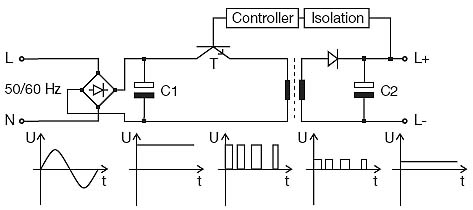
In primary switch mode power supplies, the AC mains voltage is first rectified and smoothed and then chopped ("switched"). Chopping means that the DC voltage is switched periodically at a frequency of 40 to 200 kHz using a power transistor.
In contrast to linearly regulated power supplies, the power transistor does not act as a variable resistor but as a switch instead. This generates a square-wave AC voltage that is transformed to the secondary circuit using a high-frequency transformer. In the secondary circuit, the voltage is rectifi ed and smoothed. The quantity of energy transformed to the secondary circuit is controlled, depending on the load, by varying the chopping rate. The longer the transistor is conductive, the higher is the quantity of energy transformed to the secondary circuit ( pulse width modulation).
Due to the use of high-frequency AC voltage, primary switch mode power supplies have the decisive advantage that their transformer can be of much smaller size than required for the transformation of low frequencies. This reduces the weight and the dissipation inside the unit. The effi ciency of these units is between 85 and 95 %. Since the output voltage does not directly depend on the input voltage, these units can be used for a wide input voltage range and can even be supplied with DC voltage. Furthermore, it is possible to buffer short-time mains voltage breakdowns up to 200 ms. However, the power failure buffering time is limited by the size of capacitor C1 since a longer buffering time requires a higher capacity and thus a bigger size of the capacitor. Especially in case of small power supplies this is not desirable.
Therefore, a practicable compromise has to be made between the size of the power supply and the buffering time.
Primary switch mode power supplies can be used for all purposes. For example, they are suitable for the supply of all kind of electronics as well as for electromechanical applications.
[ABB]Тематики
EN
Русско-английский словарь нормативно-технической терминологии > импульсный источник электропитания с коммутацией тока на первичной стороне
См. также в других словарях:
Roger Keyes, 1st Baron Keyes — Infobox Military Person name=The Lord Keyes lived=4 October 1872 ndash; 26 December 1945 placeofbirth=Punjab, British India placeofdeath=Buckingham caption=Roger Keyes as a Commodore, 2nd Class during the Dardanelles Campaign, 1915 nickname=… … Wikipedia
King George V class battleship (1939) — The King George V class battleships (KGV) were the penultimate battleship design completed for the Royal Navy (RN). Five ships of the class were commissioned: King George V (1940), Prince of Wales (1941), Duke of York (1941), Howe (1942), and… … Wikipedia
United Kingdom — a kingdom in NW Europe, consisting of Great Britain and Northern Ireland: formerly comprising Great Britain and Ireland 1801 1922. 58,610,182; 94,242 sq. mi. (244,100 sq. km). Cap.: London. Abbr.: U.K. Official name, United Kingdom of Great… … Universalium
United States — a republic in the N Western Hemisphere comprising 48 conterminous states, the District of Columbia, and Alaska in North America, and Hawaii in the N Pacific. 267,954,767; conterminous United States, 3,022,387 sq. mi. (7,827,982 sq. km); with… … Universalium
Christianity — /kris chee an i tee/, n., pl. Christianities. 1. the Christian religion, including the Catholic, Protestant, and Eastern Orthodox churches. 2. Christian beliefs or practices; Christian quality or character: Christianity mixed with pagan elements; … Universalium
France — /frans, frahns/; Fr. /frddahonns/, n. 1. Anatole /ann nann tawl /, (Jacques Anatole Thibault), 1844 1924, French novelist and essayist: Nobel prize 1921. 2. a republic in W Europe. 58,470,421; 212,736 sq. mi. (550,985 sq. km). Cap.: Paris. 3.… … Universalium
international relations — a branch of political science dealing with the relations between nations. [1970 75] * * * Study of the relations of states with each other and with international organizations and certain subnational entities (e.g., bureaucracies and political… … Universalium
World War II — the war between the Axis and the Allies, beginning on September 1, 1939, with the German invasion of Poland and ending with the surrender of Germany on May 8, 1945, and of Japan on August 14, 1945. Abbr.: WWII * * * or Second World War (1939–45)… … Universalium
naval warfare — Military operations conducted on, under, or over the sea and waged against other seagoing vessels or targets on land or in the air. The earliest naval attacks were raids by the armed men of a tribe or town using fishing boats or merchant ships.… … Universalium
GEOGRAPHICAL SURVEY — Names The name Ereẓ Israel (the Land of Israel) designates the land which, according to the Bible was promised as an inheritance to the Israelite tribes. In the course of time it came to be regarded first by the Jews and then also by the… … Encyclopedia of Judaism
Battle of Britain — This article is about the Second World War battle. For other uses, see Battle of Britain (disambiguation). Battle of Britain Part of the Second World War … Wikipedia
